|
8000 KILOMETERS
OK, so
what's the story behind this model? Who used it and caused the
dramatic rise in price? Nick Rhodes? Dick Robes? Lymph Nodes?
Tell me, who the fuck is able to keep pace with the cryptic ways
in which the market & the synth community operates? I can't, so all I'm going to
tell you is just the story of my unit: it was owned by Skinny
Puppy and after some 20 years flown from Canada to Poland, was
subsequently bought here by a
resident of Texas (real cowboy), then died and was shipped to a tech who
couldn't fix it, shipped back, then shipped to the best tech in the
country who
fixed it, but then re-shipped to him because it broke again. The owner, with his
fingernails almost bitten to the core, was at the end of his tether -
synth pranks like that can leave you pretty discouraged. Enter Jexus. The rest from now on is boring.
WANT A HUGE RETRO SYNTH?
Buy it. It
gefrannis booj pooch boo jujube; bear-ramage. Jigiji geeji geeja
geeble boogle. Begep flagaggle vaggle veditch-waggle bagga. So don't
trust any bad word people are saying about it. Buy it now.
WANT A TURBO-JUNO?
OK let me
get a foothold some place.
The
majority of synth aficionados probably know that the words Jupiter and
Juno are closely-knit, whereas the majority of Juno aficionados
probably know that Jupiters are not simply "beefed up"
Junos. Instead of starting this piece totally from scratch, I will
treat my
Juno 60 review as a prequel
to hover around
and build on.
If you
love your Junos as I do, but feel they limit you with their sparse
features or samey sound, and you would like to do away with
those limitations yet retain the lovable basic sound - the Jupiter 6 is not the way to go. The
Jupiters have VCOs instead of DCOs, a crucial fact which ultimately
makes those two synth families substantially different (quite as
important is the fact that the JP-6 lacks the classic Roland chorus). Legendary clan
wars between the purists and the heathens, and endless forum threads in the
vein of "DCO vs VCO and why the latter is better" cultivated
by people who have too much spare time on their hands could make my
statement confusing, so I'll try to explain myself (briefly) why I judge the
Jupiter-VCO-6 option as inferior to the Juno-DCO option.
I'm not an
engineer nor a hobbyist in any fields related to physics or
electronics, so I won't give you theorethical / technical yada yada or oscilloscope graphs. I am
only interested in practical consequences and I only judge with my ears. And
even though the VCO technology is supposed to be more "analog, organic,
unstable" (and sometimes it is), whereas the DCO is always supposed to be less of these
(and most often it is), in
my ears it's the Juno family - and most specifically the Juno 6
/ 60
- which sounds
way more analog and way more organic. The Japanese did it, I don't know how, but they did it (run
for it, Marty!). Of course everybody has their own definition of
analogueness; for me, good analog tone needs to be supple
before everything else. For others it needs to be crisp, and
such people will probably judge the Jupiter-6 to be the bee's knees.
(Besides, a DCO and a DCO is not always the same thing - the DCO-based
Roland JX-8p sounds like robot's vomit when held against the Juno or
Jupiter, so go figure). A small thing to remember: the DCO Juno will
spare you the necessity of tuning ;P
WANT A VINTAGE WORKHORSE?
If you care less about the sound
(+ maintenance) and more about
expanding the
plasticity / versatility - the JP-6 is the way to go. By
itself, the Jupiter-6 is a neat classy synth with a late '70s - early
'80s feel that can produce some mighty gusts of brasses and give you a
rash of authentic goosebumps with its quite deep array of vintage,
Visage-esque leads. I get bored with sounds like that pretty fast, so
the next stage consisted of me searching for the hidden sweet spots
and possibilities within the boundaries of its narrow sliders. My
findings inspired, turned off, spooked out or entertained me
alternately. I reached the interesting conclusion that the Jupiter-6,
out of all the
vintage synths, is the one most reminiscent of the
Korg Z1 (or V-Synth) with its atonal spacey broken-glass /
giant-vacuum-cleaner FX and mutant-mosquito buzzes and
resonator-sweeps (just click my mp3 demo below if I'm being too
vague). The Europa mod with its arpeggio features will add its 2 cents
to the quirky & curious sound arrangement options and enable you,
for example, to combine waveforms so that more than one is active /
audible. The synth definitely has personality - or a set
of aggressive and mellow personalities to switch between.
(THE LAST RANT ABOUT THE SOUND)
But after
you've had enough of the "crazy / powerful stuff" or the "like a cutting knife
stuff" and get back to simply "making music" (who the
fuck has time for that, eh?), you might feel that the
overall sound is... uhm... what's the word?... specific (or
specifically unappealing;P), and your ears will have to
decide whether it - notwithstanding its versatility - is
inspiring or not (whether it's analog / organic / full-blooded /
whatever, or not). If you are familiar with the sound of the Prophets
or the Polysix, it will be easier for me to give you a sense of where
the Jupiter-6 stands, because its general tone is like a mixture of
the quintessential Juno and the Polysix / Prophet tone. Unfortunately
this is not the instance when the final mixture is more than the sum
of its ingredients. Here the mixture turns out to be generally less
tasty than if we decided to eat the ingredients separately one by one.
(And it's
not that I want every synth to sound like a Juno-60. It would be
fantastic if every model in the world sounded different - variety is
the spice of life. But the JP-6 often just seems like a glassy Juno.
Generally classy, yet often icy / glassy. Is that okay for a synth of this
sort?)
ADDONS vs BUMMERS
That's it,
as far as the subjective and elusive concept of sound is concerned.
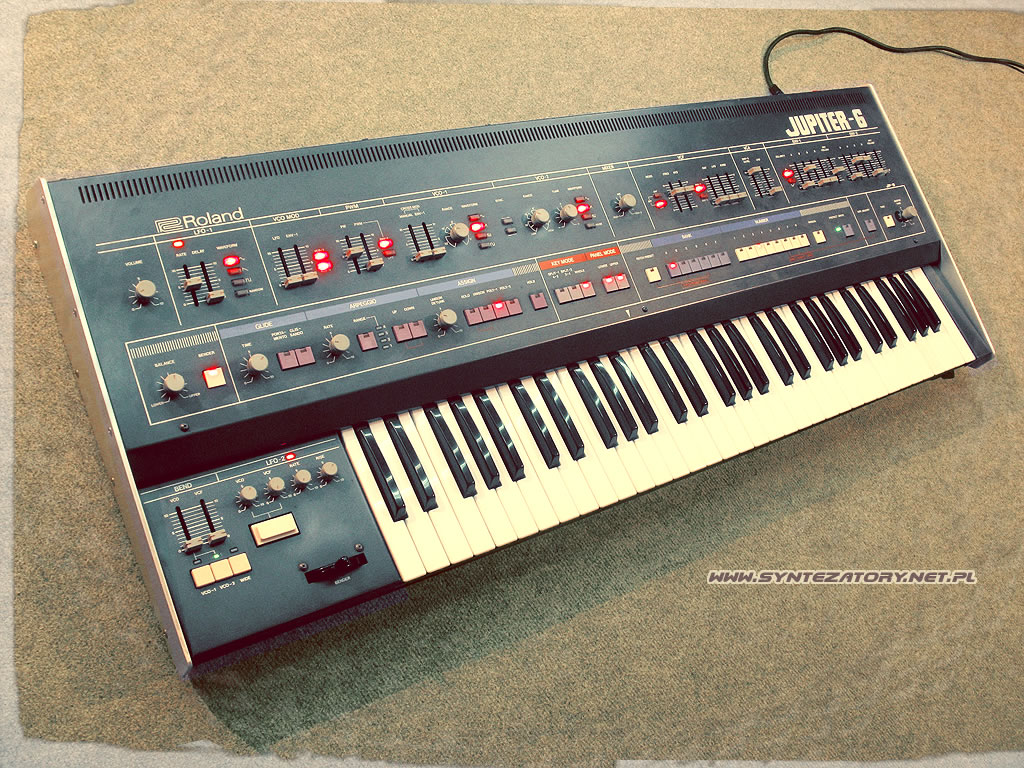
Now let's look at the physicality of this thing; it's huge. The
panel is twice as large as in your average analog synth,
and even though its size is dictated by the necessary amount of
electronic components, one might be tempted
to think that such size will inevitably bring with itself a multitude of addons. Or
will it?... To be mathematically objective, it does have some fine
addons. The
various shapes of the fast LFO, the additional envelope, the bandpass
filter, the two 4-waveform oscillators plus all the little choices to
control the routing (eg. VCF control by ENV1 or ENV2) are
surely appreciated on the JP-6. They expand the
overall scope of patches and sound variety of the machine, and will let
you achieve sounds that the Polysiks & CO can only dream of. But the somewhat unmusical
(in a "musical noise" sense / context)
cross-mod section and the lack of another LFO is a major bummer
that leaves the synth disappointingly lacking.
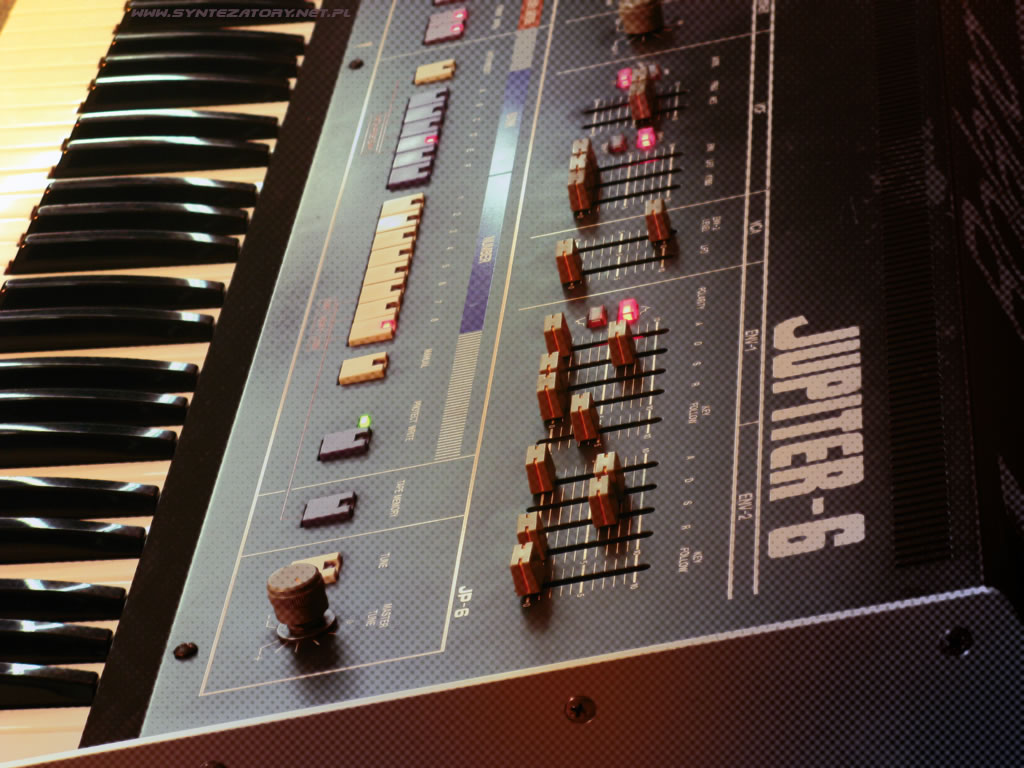
Another thing regarding the physical aspect of the synth - one that
goes against common sense - is that the larger size of the panel did
not translate to better comfort & precision of editing; the sliders on
the JP-6 are quite short, and pretty soon after pushing them up, you
reach the end of the editing scope.
However, the
Unison mode is groovy and produces very musical results, unlike other synths whose unisoned "phat" sound makes me want to
quickly abandon the premises to avoid the apparent attack of a fat,
ob-noxious insect or rodent. I don't understand the common argument that
JP-6 is bad for basses... I think it's neither bad, nor so-so. It's
properly okay. And the JP-6 Unison has the detune spread knob. And there's the
mixer knob so you can control the balance between the oscillators'
volume instead of just switching them on and off. And... I hope I've
mentioned everything essential.
RATIONALITY vs ROMANCE
OK, let's wrap it up somehow. The Juipter-6 is a cool / proper synth.
The bottom line is that it is a more-than-ordinary machine, and that
it gives us an area of fun & uniqueness that will not be covered or imitated by any Juno or JX
(first and foremost because those synths don't have a bandpass filter).
However, the peculiarity
of its
uniqueness makes me wish I had spent the money on a [JD-800 / Juno] plus a
[Polysix / Prophet 600] instead. What exactly is this peculiar (or
particular) uniqueness? Ugh... I think it's the qualities &
nuances appreciated only by vintage-analog freaks, and the communal
sense of taking part in a big chunk of music history &
heritage. There will surely be several
sounds
to
be missed (as with every synth), like those unisoned hairy basses and Elka-Synthex-like string-pads
(and all things crazy and powerful :P) . But when our
nebulous artistic ideas or nostalgic mental journeys have toned down, the
realistic question must be asked: what practical outcome do we arrive
at? We have a synth that (1) in general sounds relatively stiff-ish and
cold-ish, (2) has a questionable amount or effectiveness of its
additional features, and (3) costs threefold of the average synth
price. That sounds like a bad deal to me; the payoff seems to small. Better
leave it where it belongs: in the collector's realm.
ps. I'm
kidding. Don't be such a cold son-of-a-dog. Be less calculating and more romantic and just buy it, if
only for a couple of months:P There's only a couple of thousands left
and some of its sounds are unbeatable.
ps2.
I'm kidding. Be careful with releasing your emotions. They have always
led men astray and into deep shit.
|